
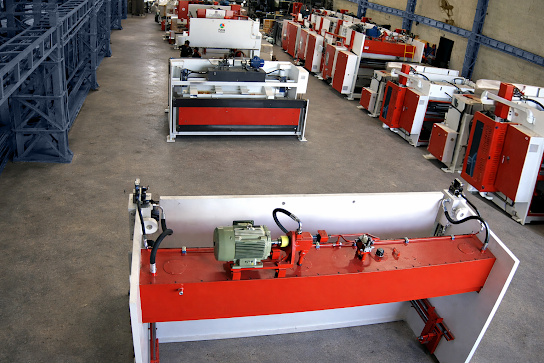
A CNC Press Brake Machine is an essential machine used in modern sheet metal manufacturing. It is designed to bend metal sheets into accurate shapes and angles according to specific production requirements. With advanced CNC technology, manufacturers can achieve high precision, repeatability, and efficient production.
What Is a CNC Press Brake?
A CNC press brake is a sheet metal bending machine that uses a punch and die system to form metal sheets. The CNC controller manages important operations such as bending angle, back gauge positioning, bending sequence, and other machine parameters.
This automated control allows manufacturers to produce consistent components with excellent accuracy and reduced manual adjustment.
How Does a CNC Press Brake Work?
During the bending process, the sheet metal is positioned between the punch and die. The upper beam then moves downward and applies controlled pressure to form the required bend.
The CNC system controls parameters such as material thickness, bending angle, bending length, and back gauge position. Once the program is set, the machine can repeat the same bending operation accurately across multiple components.
Main Components of a CNC Press Brake
A CNC press brake consists of several important components, including the CNC control system, hydraulic system, machine frame, punch and die, and back gauge system.
The CNC controller allows the operator to program the bending process, while the hydraulic system generates the required bending force. The punch and die determine the shape of the bend, and the back gauge positions the sheet accurately before each operation.
Benefits of CNC Press Brake Machines
CNC press brakes provide high bending accuracy and excellent repeatability. They can also improve production speed, reduce material wastage, and minimize manual adjustments.
Because bending programs can be stored and reused, the machine is especially useful for manufacturers producing large quantities of identical or complex sheet metal components.
Applications of CNC Press Brake Machines
CNC press brakes are widely used in sheet metal fabrication, automotive manufacturing, electrical panel production, HVAC equipment, industrial enclosures, construction equipment, agricultural machinery, and general engineering.
They are suitable for producing components that require accurate and consistent bends, from simple brackets to complex industrial parts.
CNC Press Brake vs Conventional Press Brake
A major advantage of a CNC press brake is its automated control. CNC machines can store bending programs and automatically control important parameters, reducing the amount of manual adjustment required.
Conventional press brakes generally require more manual positioning and setup. For manufacturers focused on precision, productivity, and repeatable production, CNC technology can provide significant advantages.
Important Factors When Choosing a CNC Press Brake
When selecting a CNC Press Brake Machine, manufacturers should consider the required bending length, machine tonnage, maximum sheet thickness, CNC axes, throat depth, stroke length, back gauge system, tooling, and controller.
The machine should be selected according to the type of material, component dimensions, production volume, and required bending accuracy.
Maintenance of CNC Press Brake Machines
Regular maintenance is important for maintaining machine performance and bending accuracy. Hydraulic oil, connections, tooling, moving components, and the back gauge should be inspected regularly.
Keeping the machine clean and following the manufacturer’s recommended maintenance schedule can also help improve reliability and extend the working life of the equipment.
Conclusion
A CNC Press Brake Machine is an important solution for modern sheet metal bending. Its CNC-controlled operation, precision tooling, and repeatable performance allow manufacturers to improve production efficiency while maintaining consistent product quality.
For companies involved in sheet metal fabrication and industrial manufacturing, choosing a reliable CNC press brake with suitable specifications can help achieve greater accuracy, productivity, and long-term manufacturing performance.