
A CNC bending machine transforms flat metal sheets into accurately shaped components by applying controlled force through a punch and die. It uses computer numerical control (CNC) technology to manage bending angles, positioning, movement, and repeatability.
But how does a CNC bending machine work in an actual manufacturing process?
The machine first receives a programmed design and bending parameters. The operator positions the sheet metal, and the CNC-controlled backgauge aligns it for bending. The ram then moves the punch toward the die, applying force that permanently changes the shape of the metal.
This automated process helps manufacturers produce brackets, panels, enclosures, channels, frames, and other sheet metal components with consistent dimensions.
Understanding the CNC bending process is useful for manufacturers who want to improve production accuracy, reduce manual errors, and make better decisions about sheet metal machinery.
What Is a CNC Bending Machine?
A CNC bending machine is a computer-controlled machine used to bend sheet metal or metal plates into specific angles and shapes.
Most industrial CNC bending machines operate as press brakes. They use an upper punch and a lower die to apply force to the workpiece.
The CNC system controls important parameters such as:
- Ram position
- Bending angle
- Backgauge position
- Bending sequence
- Machine-axis movement
- Processing parameters
Unlike traditional manual bending, the machine can store programs and repeat the same bending sequence for multiple components.
This makes it suitable for manufacturing environments where dimensional accuracy, production consistency, and flexible part design are important.
How Does a CNC Bending Machine Work?
A CNC bending machine works by positioning a metal sheet between a punch and die, then applying controlled force to deform the material into the required angle.
The machine follows a programmed sequence that combines positioning, tooling movement, force application, and material deformation.
Step 1: Create or Load the Bending Program
The process begins with a component design or bending program.
The operator or programmer enters the required information into the machine controller. Depending on the CNC system, this information may include:
- Material type
- Material thickness
- Part dimensions
- Required bend angles
- Bending length
- Tooling selection
- Bend sequence
- Backgauge positions
Advanced CNC controllers can calculate bending parameters and help identify a suitable sequence for producing the component.
Some systems also provide 2D or 3D simulations to visualise the bending operation before actual production begins.
Step 2: Select the Punch and Die
The punch and die are the primary tools responsible for shaping the sheet metal.
The upper punch is mounted on the moving ram, while the lower die is installed on the machine bed.
Different tooling profiles are used depending on:
- Required bend angle
- Material thickness
- Inside bend radius
- Material properties
- Component geometry
- Bending method
For example, a V-shaped die is commonly used for air bending, while specialised tools may be required for particular shapes or applications.
Correct tooling selection is important because it influences bending force, angle accuracy, surface finish, and the final component geometry.
Step 3: Position the Sheet Metal
The operator places the flat sheet on the machine bed and aligns its reference edge against the backgauge.
The backgauge acts as a positioning system. It determines how far the sheet is placed from the bending line, helping control the flange dimension.
In a CNC system, the backgauge automatically moves to the programmed position.
Depending on the machine configuration, multiple axes may control backgauge movement, allowing the system to position different parts of the sheet for complex bending operations.
Accurate positioning helps reduce dimensional errors and improves consistency between repeated components.
Step 4: The Ram Moves Downward
After the material is positioned and the bending cycle is initiated, the machine moves the upper ram toward the sheet.
The ram carries the punch, which applies force to the metal.
Depending on the machine design, the movement may be powered by hydraulic cylinders, electric drives, or other mechanisms.
The CNC control system manages the movement according to the programmed position and operating parameters.
During this stage, the machine approaches the workpiece and begins the forming operation.
Step 5: The Punch Presses the Metal Into the Die
When the punch contacts the sheet, the applied force causes the material to deform.
The sheet is supported by the lower die while the punch pushes it downward.
As the force increases, the metal passes beyond its elastic limit and undergoes permanent deformation.
The metal does not return completely to its original flat shape after the force is removed. Instead, it retains the newly formed bend.
This is the fundamental working principle of a press brake.
Step 6: The CNC Controls the Bending Depth and Angle
The bending angle is influenced by how deeply the punch enters the die, the tooling geometry, material properties, and the bending method.
In air bending, the sheet does not fully contact the bottom of the die. The punch penetration controls the angle.
The CNC controller regulates ram position to achieve the programmed bending depth.
Depending on the system, feedback devices such as position sensors or linear scales may monitor ram movement and help maintain positioning accuracy.
The controller can also account for material-related corrections, depending on its features and the setup used.
Step 7: The Ram Retracts and the Metal Springs Back
After reaching the programmed bending position, the ram moves upward and releases the applied force.
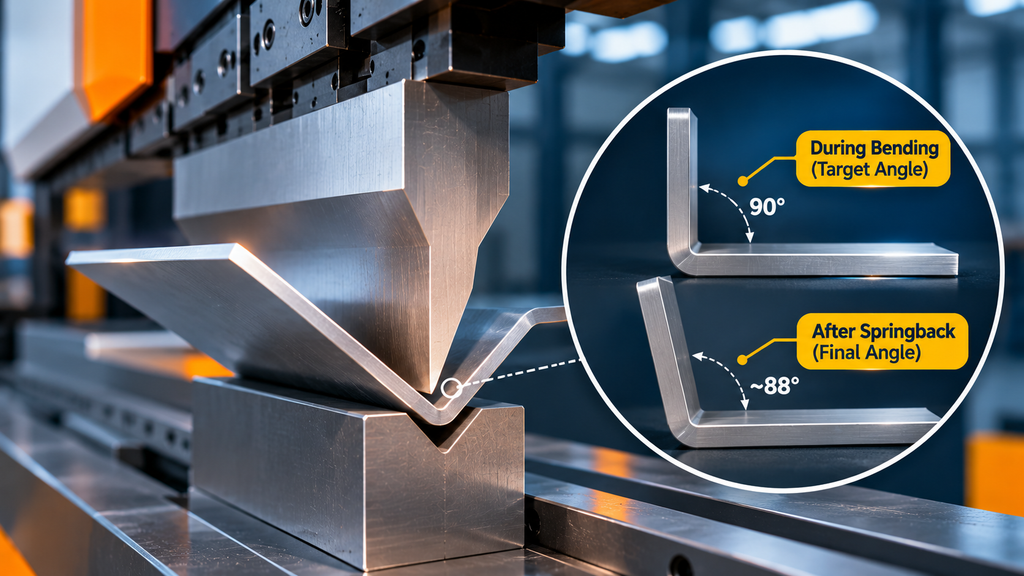
The metal experiences a small elastic recovery known as springback.
Springback occurs because some of the material deformation remains elastic during the bending operation. When the force is removed, this elastic portion partially recovers.
For example, a metal sheet bent under pressure may open slightly after the punch retracts.
The CNC system or operator may compensate for this effect by adjusting the bending depth or programmed angle.
The amount of springback depends on material type, thickness, tensile strength, bend radius, and forming conditions.
Step 8: The Sheet Is Repositioned for the Next Bend
Many sheet metal components require multiple bends.
After the first bend, the operator repositions the sheet or the backgauge moves automatically to the next programmed location.
The machine repeats the bending cycle until all required bends are completed.
The bending sequence is important because the shape created by one bend may affect access to the next bending position.
A properly planned sequence helps prevent collisions between the workpiece, punch, die, and machine structure.
Step 9: The Finished Component Is Checked
Once the bending operation is complete, the finished component is inspected.
The operator checks important dimensions such as:
- Bend angle
- Flange length
- Overall dimensions
- Bend position
- Surface condition
- Part alignment
The first component is often checked carefully before the remaining production batch is processed.
If adjustments are required, the program or bending parameters may be corrected to improve the subsequent results.
What Are the Main Components of a CNC Bending Machine?
Several key components that work together to produce accurate bending results.
1. Machine Frame
The frame supports the machine structure and withstands the forces generated during the bending operation.
A rigid frame helps maintain structural stability and supports accurate machine movement.
2. Ram or Upper Beam
The ram is the moving section that carries the upper punch.
Its movement determines the punch position during the forming cycle.
3. Punch
The punch is the upper tool that applies force to the metal sheet.
Different punch profiles can be used to create different bends and shapes.
4. Die
The die is the lower tool that supports the material during bending.
Its opening and shape influence the required bending force, inside radius, and final angle.
5. Backgauge
The backgauge positions the metal sheet before each bending operation.
CNC-controlled backgauges can move automatically according to the program, improving positioning accuracy and production repeatability.
6. CNC Controller
The CNC controller is the machine’s control centre.
It manages programmed bending operations, machine movement, positioning, and operating parameters.
Depending on the model, the controller may support graphical programming, bend-sequence calculations, simulations, and stored production programs.
7. Drive System
The drive system provides the force and movement required for bending.
Common machine configurations include hydraulic, electric, and hybrid systems.
Each configuration has different operating characteristics, energy requirements, maintenance considerations, and performance capabilities.
8. Crowning System
During bending, machine components may deflect slightly under load.
A crowning system compensates for this deflection to help maintain consistent bending angles across the working length.
This is particularly useful when processing longer components.
What Is the CNC Bending Machine Work Process?
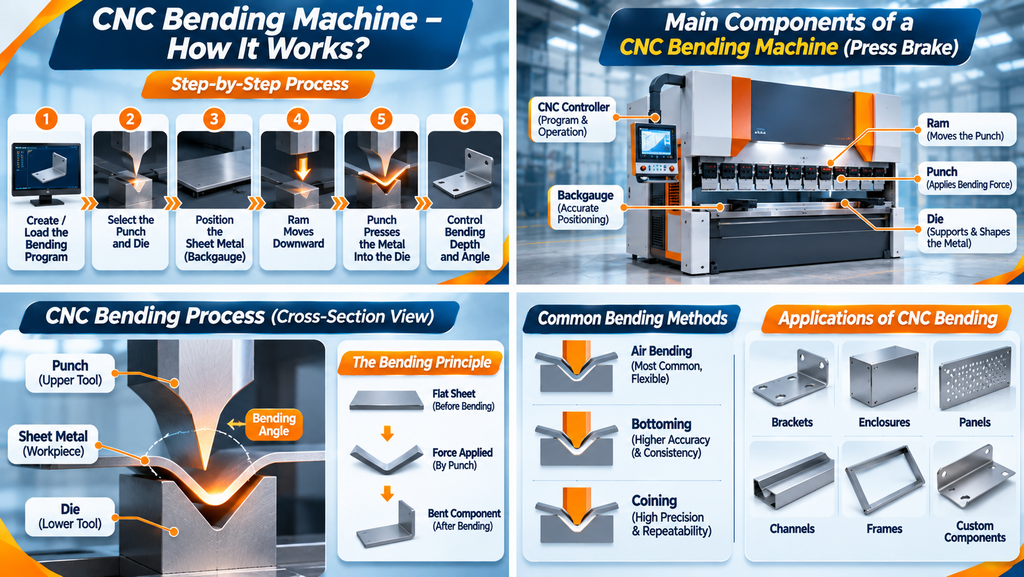
The CNC Bending Machine Work process follows a systematic sequence from design preparation to finished-component inspection.
| Process Stage | What Happens |
|---|---|
| Design preparation | Component dimensions and bend requirements are defined |
| CNC programming | Bending sequence and parameters are entered |
| Tool setup | Suitable punch and die are installed |
| Material positioning | Sheet is aligned against the backgauge |
| Bending operation | Punch applies force to form the required bend |
| Ram retraction | Machine releases the applied force |
| Repositioning | Sheet moves to the next bend location |
| Quality inspection | Finished component is checked for accuracy |
This process allows manufacturers to produce components repeatedly using stored programs.
What Are the Different Types of CNC Bending Machines?
Different types of CNC bending machines are designed for different material shapes and production applications.
CNC Press Brake
A CNC press brake is commonly used for bending flat sheet metal and plates.
It produces straight bends such as:
- V-bends
- U-shaped components
- Channels
- Brackets
- Enclosures
- Flanges
The machine uses a punch-and-die arrangement and controlled ram movement.
CNC Tube Bending Machine
CNC tube bending equipment is designed for bending metal tubes and pipes.
It controls tube positioning, rotation, and bending movement to produce curved components.
Common applications include automotive structures, furniture frames, industrial piping, and exhaust systems.
Panel Bending Machine
Panel bending machines are designed for efficiently forming sheet metal panels.
They are commonly used for cabinets, doors, electrical enclosures, and larger panel components.
Their bending mechanism and automation configuration differ from conventional press brakes.
Hydraulic CNC Bending Machine
Hydraulic bending machines use hydraulic power to generate bending force.
They are commonly used in industrial applications requiring substantial forming capacity.
The CNC system controls ram movement and other programmable functions depending on the machine configuration.
What Are the Common Bending Methods?
Different bending methods can be used depending on the required angle, material, tooling, and component design.
Air Bending
Air bending is one of the most widely used bending methods.
The punch presses the sheet into the die opening without forcing it completely to the bottom.
The angle is primarily controlled by punch penetration depth.
This method offers flexibility because different angles can often be produced using the same tooling setup.
Bottoming
During bottoming, the sheet is pressed more closely against the die surfaces.
The tooling geometry plays a greater role in forming the final bend.
Bottoming may provide different accuracy and repeatability characteristics compared with air bending, but it generally requires more force.
Coining
Coining applies higher pressure to force the material more closely into the tooling shape.
It is used in applications where the forming requirements justify the higher force and tooling demands.
The appropriate bending method depends on material, machine capacity, required accuracy, production volume, and tooling availability.
What Factors Affect Bending Accuracy?
Bending accuracy depends on several machine, tooling, and material factors.
Material Thickness
Small variations in sheet thickness can influence bending force and final angle.
Consistent material thickness helps maintain repeatable results.
Material Properties
Different metals behave differently during bending.
Material strength, hardness, grain direction, and elastic recovery can influence the final bend.
Tooling Condition
Worn or incorrectly selected tooling can affect angle, radius, surface finish, and dimensional consistency.
Backgauge Position
Accurate positioning determines where the bend occurs.
Incorrect backgauge settings can produce flange-length errors.
Bending Parameters
Ram depth, force, speed, and compensation settings influence the bending result.
Machine Calibration
Proper machine calibration and maintenance help maintain positioning accuracy and repeatability.
Bend Sequence
The order of bending operations can influence part handling, collision risks, and final dimensions.
Correct sequence planning is particularly important for components with multiple bends.
What Are the Advantages of CNC Bending?
CNC technology offers several advantages for sheet metal fabrication.
Improved Repeatability
Stored programs allow the machine to repeat the same operation across multiple components.
Better Positioning Accuracy
Programmable backgauges and controlled ram movement help reduce positioning variation.
Reduced Manual Adjustment
Automation reduces the need for repeated manual measurement and adjustment during production.
Flexible Production
Different component designs can be produced by changing programs and tooling configurations.
Complex Bending Capability
CNC systems help manage multiple bending steps and more complicated part geometries.
Improved Productivity
Automated positioning and programmed sequences can reduce setup and production time for suitable applications.
How Is CNC Bending Used in Metal Fabrication?
CNC bending is used to manufacture components across several industries.
Common applications include:
- Electrical control panels
- Machine covers
- Metal cabinets
- Industrial enclosures
- Automotive brackets
- Structural components
- Sheet metal frames
- Furniture parts
- HVAC duct components
- Equipment housings
In a typical fabrication workflow, sheet metal may first be cut to the required dimensions using a cutting process. It is then bent into the required geometry and assembled through welding, fastening, or other manufacturing operations.
For example, manufacturers may use a laser cutting machine to produce a flat component before bending it into a bracket or enclosure.
The cutting and bending stages work together to create the final component.
For a related explanation of the cutting stage, read How Does Fiber Laser Cutting Work? A Complete Guide.
What Should You Consider Before Choosing a CNC Bending Machine?
Selecting suitable equipment requires understanding the actual production requirements.
Consider the following factors before purchasing:
- Maximum material thickness
- Common material types
- Required bending length
- Required bending force or tonnage
- Part complexity
- Required angle accuracy
- Production volume
- Number of controlled axes
- CNC controller features
- Tooling compatibility
- Operator skill requirements
- Maintenance and service support
The machine should be selected according to the components you plan to manufacture.
A machine with advanced features may be useful for complex production, while a simpler configuration may be sufficient for basic bending applications.
Manufacturers evaluating a cnc bending machine should compare machine specifications, bending capacity, control features, tooling options, and application suitability rather than focusing on a single specification.
Conclusion
Understanding how a CNC bending machine works helps manufacturers understand how flat metal sheets become accurately formed components.
The process begins with CNC programming and tooling setup. The sheet is positioned against the backgauge, and the ram moves the punch toward the die. Controlled force permanently deforms the material into the required shape.
The machine then retracts, compensates for material springback where required, and repositions the sheet for subsequent bends.
CNC technology improves repeatability by coordinating ram movement, positioning, bending parameters, and programmed sequences.
For modern sheet metal fabrication, selecting the right bending technology, tooling, and machine configuration is essential for producing accurate components efficiently.
Businesses exploring metal fabrication machinery and bending solutions can learn more about Purvaj Engineers and its industrial machinery offerings.
Frequently Asked Questions
How does a CNC bending machine work?
A CNC bending machine works by positioning metal sheet between a punch and die, then applying controlled force to create a programmed bend. The CNC system manages positioning, ram movement, and bending parameters.
What is the working principle of a CNC press brake?
A CNC press brake uses a punch and die to deform sheet metal. The ram moves the punch into the die opening, creating a permanent bend when the material passes beyond its elastic limit.
What is the difference between a CNC and manual bending machine?
A CNC machine uses programmable controls for positioning and bending operations, while manual machines depend more heavily on operator adjustments and positioning. CNC systems generally offer better repeatability for programmed production.
What materials can a CNC bending machine bend?
Depending on its capacity and tooling, a CNC bending machine can bend mild steel, stainless steel, aluminium, and other suitable sheet metals. Material thickness and strength must be considered when selecting bending parameters.
What controls the bending angle?
The bending angle is influenced by punch penetration, tooling geometry, material properties, thickness, and bending method. In air bending, ram depth is a major factor in controlling the angle.
What is springback in sheet metal bending?
Springback is the partial recovery of metal after bending force is removed. It can cause the bend angle to change slightly after the ram retracts, so compensation may be required.
What is the purpose of a CNC backgauge?
A CNC backgauge positions the sheet metal at the required distance from the bending line. It helps control flange dimensions and allows automatic positioning for different bending steps.
What products can be made using CNC bending?
CNC bending can manufacture brackets, panels, cabinets, enclosures, channels, frames, machine covers, automotive components, and many other sheet metal parts that require controlled bends.