
Fiber laser technology has transformed modern metal fabrication by making it possible to cut metal sheets with high precision, speed, and consistency. But how does fiber laser cutting work, and what makes this technology different from traditional cutting methods?
A fiber laser cutting machine uses concentrated light energy to heat and melt material along a programmed path. The machine combines a laser source, optical fiber, cutting head, assist gas, and CNC motion system to produce accurate shapes and edges.
Unlike mechanical cutting tools, this process does not require direct physical contact with the workpiece. The cutting head directs a powerful laser beam onto a small area, while controlled movement and gas pressure remove the molten material.
Understanding the fiber laser cutting working principle helps manufacturers choose the right machine, material, cutting parameters, and technology for their production requirements.
What Is Fiber Laser Cutting?
Fiber laser cutting is a thermal cutting process that uses a high-energy laser beam generated and amplified inside an optical fiber to cut metal materials.
The optical fiber contains a special active medium, commonly doped with rare-earth elements such as ytterbium. Energy from laser diodes excites this medium, generating light that is amplified to produce a powerful laser beam.
The beam is delivered through an optical fiber to the cutting head. A focusing lens concentrates the energy onto a very small point on the material surface.
This concentrated energy creates enough heat to melt, vaporize, or oxidize the material. Assist gas removes the molten metal from the cutting area, creating a narrow opening known as the kerf.
Fiber laser cutting is commonly used in metal fabrication industries for processing:
- Mild steel
- Stainless steel
- Carbon steel
- Aluminium
- Copper
- Brass
- Sheet metal
- Metal plates and components
The technology is particularly useful when manufacturers require accurate dimensions, repeatable production, complex shapes, and efficient material processing.
How Does Fiber Laser Cutting Work?
Fiber laser cutting works by generating laser light, amplifying it through a specialized fiber, focusing it onto metal, and removing the heated material with assist gas.
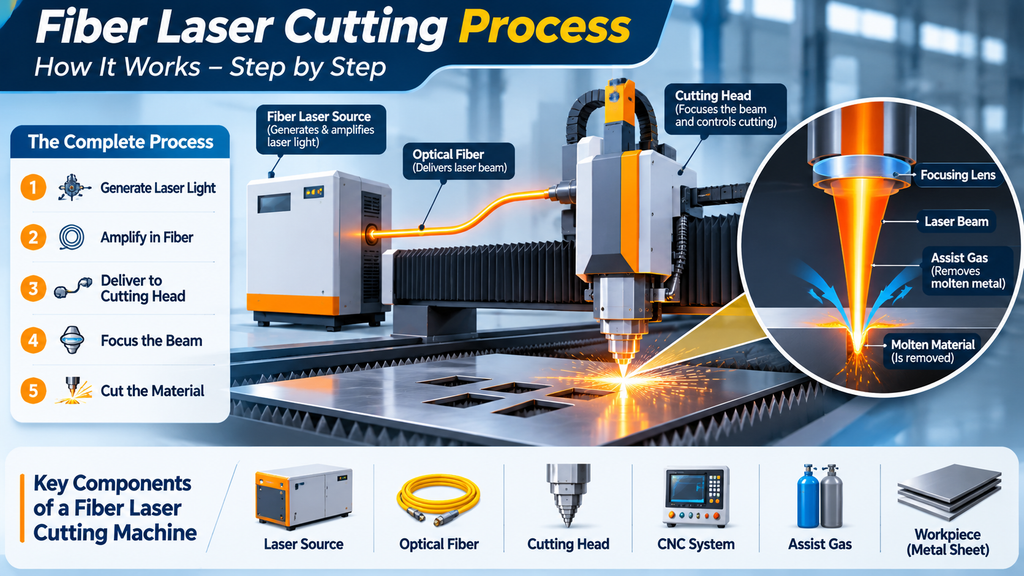
The complete fiber laser cutting process involves several connected stages.
Step 1: Electrical Energy Generates Laser Light
The process begins inside the fiber laser source.
Electrical energy powers laser diodes, which produce light used to excite the active medium inside the optical fiber. The fiber contains doped material that allows light amplification through stimulated emission.
As photons interact with the active medium, additional photons are generated with similar wavelength, direction, and phase characteristics.
This process increases the intensity of the light and produces a powerful laser beam suitable for industrial cutting applications.
Ytterbium-doped fiber is commonly used in industrial fiber laser systems because of its suitable optical properties and ability to support efficient laser generation.
Step 2: Light Is Amplified Inside the Fiber
The generated light travels through the doped fiber, where it is amplified.
The fiber laser source contains optical components that help control and amplify the light. Depending on the system design, the laser cavity and related components support the amplification process.
The result is a concentrated light beam with characteristics suitable for metal cutting.
Unlike traditional CO₂ laser systems, fiber laser technology delivers the generated light through an optical fiber rather than relying on a long arrangement of beam-delivery mirrors.
This makes the system more compact and helps simplify beam delivery to the cutting head.
Step 3: The Laser Beam Travels to the Cutting Head
Once the laser beam is generated, it travels through a specialized optical fiber cable toward the cutting head.
This cable carries the laser energy while protecting the beam delivery pathway from external disturbances.
The cutting head contains optical components that prepare the beam for the cutting process.
These components typically include:
- Collimating optics
- Focusing lens
- Cutting nozzle
- Protective optical elements
- Height-sensing components
The optical system helps maintain beam quality and directs the energy toward the required cutting position.
Step 4: The Beam Is Focused on the Metal Surface
The cutting head contains a focusing lens that concentrates the laser beam into a very small spot.
When energy is focused into a small area, its power density increases significantly. This allows the material to heat rapidly at the cutting point.
The focused beam creates a localized thermal zone instead of heating the entire sheet.
The focal position, beam diameter, laser power, nozzle position, and cutting speed all influence the cutting result.
Proper focusing is important for achieving:
- Narrow kerf width
- Accurate dimensions
- Smooth edges
- Reduced unwanted heat
- Consistent cutting quality
The beam must remain properly aligned and focused throughout the operation.
Step 5: The Material Absorbs Laser Energy
When the focused laser beam reaches the metal surface, the material absorbs part of the light energy.
The absorbed energy converts into heat, increasing the temperature of the material in the cutting zone.
Depending on the material and process parameters, the metal may melt, vaporize, or undergo oxidation-assisted cutting.
As the beam continues to deliver energy, a small region of molten material forms.
This localized heating is the foundation of the fiber laser cutting process.
The interaction between the material and laser energy depends on several factors, including:
- Material type
- Material thickness
- Surface condition
- Laser wavelength
- Laser power
- Cutting speed
- Beam focus
Different metals respond differently to laser energy, so cutting parameters must be selected according to the material being processed.
Step 6: Assist Gas Removes Molten Material
Assist gas plays an important role in the cutting operation.
The gas flows through the nozzle around the focused beam and reaches the cutting area. Its pressure helps remove molten metal from the kerf.
Without effective material removal, molten metal can remain inside the cut, affecting edge quality and potentially interrupting the process.
Common assist gases include:
Nitrogen: Often used when manufacturers require clean edges with reduced oxidation, particularly in stainless steel and other applications where surface finish matters.
Oxygen: Can support cutting through an oxidation reaction that generates additional heat. It is commonly used for certain carbon steel applications.
Compressed air: May be used for suitable materials and thicknesses depending on machine capability, required finish, and operating conditions.
Gas selection affects cutting speed, edge appearance, oxidation, burr formation, and operating cost.
Step 7: CNC Movement Creates the Required Shape
The machine does not cut randomly. It follows a digital design or programmed cutting path.
A CNC control system interprets the cutting program and controls the movement of the machine axes.
Servo motors and motion-control components move the cutting head or workpiece according to the programmed geometry.
During the operation, the control system coordinates:
- Cutting position
- Movement speed
- Laser power
- Assist gas
- Piercing sequence
- Cutting path
- Acceleration and deceleration
The laser continues heating and removing material while the cutting head moves along the programmed route.
This coordinated movement allows the machine to produce straight lines, curves, holes, slots, complex contours, and customized components.
Once the programmed path is completed, the machine stops the cutting operation and the finished part can be removed.
What Are the Main Components of a Fiber Laser Cutting Machine?
A fiber laser cutting machine combines multiple systems that work together to produce accurate cuts.
1. Fiber Laser Source
The laser source generates the high-energy beam used for cutting.
Its output power and beam characteristics influence the machine’s processing capability, cutting speed, and material thickness range.
2. Optical Fiber
The optical fiber transports laser energy from the source to the cutting head.
It provides a flexible beam-delivery pathway and eliminates the need for the traditional mirror-based delivery arrangement used in many CO₂ systems.
3. Cutting Head
The cutting head directs the beam toward the material.
It contains focusing optics and the nozzle used for assist gas delivery.
The cutting head also helps maintain the correct distance between the nozzle and material surface, depending on the machine’s height-control system.
4. CNC Control System
The CNC system converts digital designs into machine instructions.
It controls movement, cutting speed, laser output, and other process parameters to help produce repeatable parts.
5. Servo Motor and Motion System
Servo motors control machine-axis movement.
Their response and positioning accuracy help the machine follow complex cutting paths and maintain consistent movement.
6. Assist Gas System
The gas system supplies the required gas at controlled pressure and flow.
It helps remove molten metal and supports the selected cutting process.
7. Machine Bed and Worktable
The machine structure supports the material during cutting.
A stable machine bed helps maintain positioning accuracy and supports the motion system during production.
What Is the Fiber Laser Cutting Working Principle?
The fiber laser cutting working principle is based on the conversion of electrical energy into amplified light energy, followed by the concentration of that energy into a small area of material.
The basic process can be represented as:
Electrical Energy → Laser Diodes → Active Fiber → Light Amplification → Optical Fiber Delivery → Focused Beam → Material Heating → Melt Removal → Finished Cut
The fiber laser source generates light using laser pumping.
The active medium amplifies the light through stimulated emission. Optical components help control the generated beam, which travels through the delivery fiber toward the cutting head.
The focusing lens concentrates the beam onto the workpiece. The material absorbs the energy and heats rapidly.
The assist gas removes molten material while the CNC system moves the beam along the required cutting path.
All these processes happen in coordination, allowing the machine to produce accurate metal components.
What Materials Can a Fiber Laser Cut?
Fiber laser technology is primarily used for metal processing because many metals efficiently absorb its wavelength.
Common materials include:
| Material | Common Applications |
|---|---|
| Mild steel | Fabrication frames, brackets, panels |
| Stainless steel | Industrial equipment, enclosures, kitchen components |
| Carbon steel | Structural parts and machine components |
| Aluminium | Automotive, electrical and lightweight components |
| Copper | Electrical and industrial applications |
| Brass | Decorative, electrical and precision components |
The cutting capability depends on the laser source power, material thickness, machine configuration, cutting head, assist gas, and processing parameters.
Not every material is suitable for every machine. Material compatibility and manufacturer recommendations should be checked before processing.
What Are the Different Types of Fiber Lasers?
Fiber lasers can be classified according to their operating characteristics and applications.
Continuous-Wave Fiber Lasers
Continuous-wave lasers produce a continuous output of laser energy during operation.
They are widely used in industrial metal cutting because they provide sustained energy for continuous cutting paths.
Pulsed Fiber Lasers
Pulsed systems release laser energy in controlled pulses rather than as a continuous beam.
They are commonly used in applications such as laser marking, engraving, precision processing, and other operations where controlled energy delivery is important.
High-Power Fiber Lasers
High-power fiber laser systems are designed for demanding industrial cutting applications.
Higher power can expand processing capability, but the actual cutting performance also depends on beam quality, material type, thickness, focal position, gas selection, and machine configuration.
Selecting laser power should therefore be based on the intended production requirements rather than power rating alone.
Fiber Laser vs CO₂ Laser: What Is the Difference?
Both fiber and CO₂ lasers use concentrated light energy for cutting, but their laser-generation and beam-delivery technologies differ.
| Feature | Fiber Laser | CO₂ Laser |
|---|---|---|
| Laser medium | Doped optical fiber | Gas mixture |
| Beam delivery | Optical fiber | Mirrors and optics |
| Common applications | Metal cutting | Metals and selected non-metals |
| Energy efficiency | Generally higher | Generally lower |
| Maintenance | Often lower | Can require more optical maintenance |
| Reflective metals | Suitable systems can process them | Processing limitations may apply |
| Technology | Solid-state laser | Gas laser |
Fiber laser technology is widely used in modern industrial metal cutting because it offers efficient beam delivery and strong performance across many metal-processing applications.
However, the best technology depends on the material, thickness, production requirements, budget, and intended use.
What Factors Affect Fiber Laser Cutting Quality?
Cut quality depends on the interaction of several machine and process parameters.
Laser Power
Laser power influences the amount of energy delivered to the material.
The required power depends on the material, thickness, cutting speed, and process configuration.
Cutting Speed
Cutting speed determines how quickly the beam moves across the material.
If the speed is too high for the selected parameters, incomplete cutting may occur. If it is too low, excessive heat may cause unwanted effects.
Focal Position
The focal position determines where the beam’s highest energy concentration is located.
Incorrect focusing can affect kerf width, cutting stability, and edge quality.
Assist Gas and Pressure
The gas type and pressure influence molten material removal, oxidation, edge finish, and cutting stability.
Material Quality
Material thickness, surface condition, composition, and consistency can affect cutting results.
Machine Condition
Clean optics, stable motion, correct nozzle selection, proper alignment, and regular maintenance help maintain reliable cutting performance.
These parameters must be adjusted according to the material and application.
What Are the Benefits of Fiber Laser Cutting?
Fiber laser cutting offers several advantages for modern manufacturing.
High Cutting Precision
The focused beam can create narrow cuts and complex geometries.
This makes the process suitable for components that require accurate dimensions and detailed shapes.
Faster Processing
Depending on material and thickness, fiber laser systems can process many sheet-metal applications at high speeds.
This helps manufacturers improve productivity and reduce processing time.
Reduced Mechanical Contact
The process does not rely on a physical cutting blade contacting the workpiece.
This reduces mechanical tool wear associated with conventional cutting methods.
Flexible Production
A CNC program can be modified to produce different designs without changing a mechanical cutting tool.
This supports custom fabrication, prototypes, and batch production.
Efficient Energy Use
Fiber laser technology generally provides efficient electrical-to-optical energy conversion compared with many traditional industrial laser technologies.
Consistent Results
When the machine, material, and process parameters are properly controlled, fiber laser systems can produce repeatable cutting results.
Where Is Fiber Laser Cutting Used?
Fiber laser cutting is used across several manufacturing and fabrication industries.
Automotive Industry
Manufacturers use laser cutting to produce brackets, panels, structural parts, and precision metal components.
Industrial Machinery
Machine manufacturers use the technology for frames, covers, enclosures, support structures, and custom parts.
Electrical Equipment
Laser cutting is used for metal cabinets, electrical enclosures, mounting plates, and related components.
Metal Fabrication
Fabrication businesses use laser technology to cut sheet metal into custom shapes for assembly, welding, and finishing.
Furniture and Interior Manufacturing
Metal furniture components, decorative panels, frames, and customized designs can be produced using programmed cutting paths.
What Should You Consider Before Using a Fiber Laser Cutting Machine?
Before selecting or operating a fiber laser cutting machine, manufacturers should evaluate the actual production requirements.
Important considerations include:
- Material types to be processed
- Maximum and commonly used thicknesses
- Required cutting accuracy
- Production volume
- Desired cutting speed
- Laser source power
- Assist gas availability and cost
- Machine working area
- CNC software and compatibility
- Operator training
- Maintenance requirements
- Safety systems
The right machine should match the production application rather than simply having the highest power rating.
For businesses processing different metal types and thicknesses, a proper evaluation of machine specifications and cutting requirements can help avoid unnecessary investment.
How Does Fiber Laser Cutting Compare With Other Cutting Technologies?
Different cutting technologies are designed for different applications.
Mechanical cutting uses physical tools and force to separate material. It may be suitable for specific production requirements but can involve tool wear and limitations when producing complex shapes.
Plasma cutting uses an electrically conductive gas to create a high-temperature plasma arc. It is commonly used for metal cutting, particularly where material thickness and production requirements make it suitable.
Waterjet cutting uses a high-pressure water stream, often combined with abrasive material, to cut workpieces. It can process materials that are sensitive to heat.
Fiber laser cutting uses concentrated light energy to process material through localized heating and material removal.
The best technology depends on material, thickness, accuracy, edge quality, production speed, and overall operating cost.
Conclusion
Understanding how fiber laser cutting works makes it easier to evaluate this technology for modern metal fabrication.
The process starts with laser generation and amplification inside the fiber laser source. The beam travels through an optical fiber to the cutting head, where a lens focuses it onto the material.
The concentrated energy heats and melts the metal. Assist gas removes the molten material, while the CNC motion system guides the beam along the programmed path to create the required shape.
The final cutting result depends on the coordination of laser power, material properties, focusing, cutting speed, assist gas, and machine accuracy.
For manufacturers looking to improve precision, flexibility, and productivity in metal fabrication, fiber laser technology can be an effective solution when selected according to the actual application and production needs.
Businesses looking for metal fabrication machinery and industrial solutions can explore the offerings available from Purvaj Engineers
Frequently Asked Questions
1. How does fiber laser cutting work in simple terms?
Fiber laser cutting works by focusing a powerful light beam onto metal. The concentrated energy heats and melts the material, while assist gas removes the molten metal and a CNC system guides the beam along the required cutting path.
2. What is the fiber laser cutting working principle?
The working principle is based on generating and amplifying light inside a doped optical fiber. The amplified beam is focused onto metal, creating localized heat that melts or removes the material.
3. What is used to generate a fiber laser beam?
Laser diodes generate pumping light that excites the active medium inside a doped fiber. This process amplifies light through stimulated emission and produces the laser beam.
4. What gas is used in fiber laser cutting?
Nitrogen, oxygen, and compressed air may be used depending on the material, thickness, cutting requirements, and desired edge quality.
5. Can a fiber laser cut aluminium and copper?
Yes, suitable fiber laser cutting systems can process aluminium and copper. However, cutting performance depends on the laser power, material thickness, machine configuration, and processing parameters.
6. What is the difference between fiber laser cutting and CO₂ laser cutting?
Fiber lasers generate light using a doped optical fiber and deliver it through a fiber-optic cable. CO₂ lasers generate light using a gas-based medium and commonly use mirror-based beam delivery. Their efficiency and material-processing characteristics differ.
7. Does fiber laser cutting require physical contact with metal?
No. Fiber laser cutting is a non-contact thermal process. The cutting head directs energy onto the material without using a physical blade to cut it.
8. What affects the cut quality of a fiber laser cutting machine?
Cut quality depends on laser power, cutting speed, focal position, assist gas, nozzle condition, material thickness, material quality, machine accuracy, and maintenance.
[…] For a related explanation of the cutting stage, read How Does Fiber Laser Cutting Work? A Complete Guide. […]