
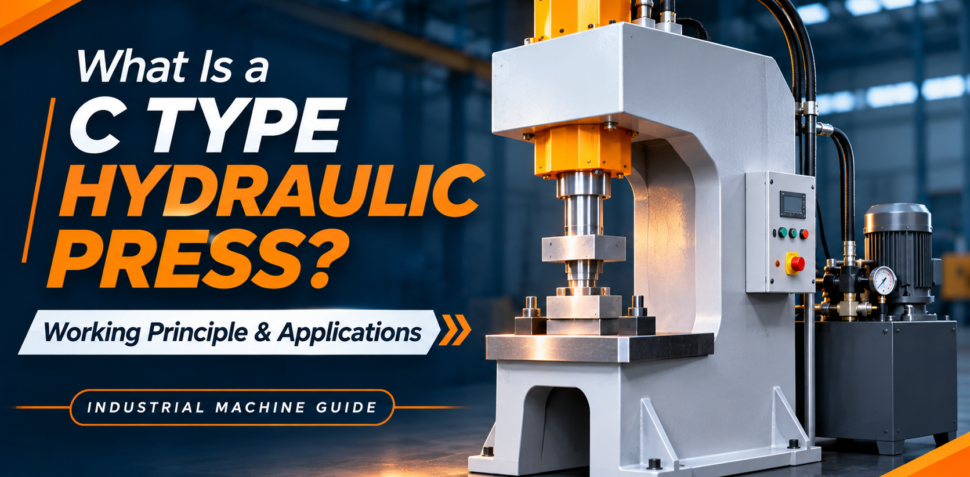
A hydraulic press is an industrial machine used to apply controlled force for pressing, forming, bending, punching, assembling, and other manufacturing operations. Among the different types of hydraulic presses, the C-type design is popular because of its open structure and easy access to the working area.
But what is a C type hydraulic press, how does it work, and where is it used?
A C-type hydraulic press features a frame shaped like the letter “C”. This design allows operators to access the work area from the front and sides, making it suitable for manufacturing operations that require frequent loading, unloading, positioning, and tool changes.
It is commonly used in metalworking, component assembly, sheet metal operations, straightening, punching, pressing, and industrial production.
Understanding its construction, working principle, applications, advantages, and limitations can help manufacturers determine whether this machine is suitable for their production requirements.
What Is a C Type Hydraulic Press?
A C type hydraulic press is an industrial pressing machine that uses hydraulic force to perform manufacturing operations. It features an open C-shaped frame, a hydraulic cylinder, a moving ram, a working table, and a hydraulic power system.
The machine generates force through pressurized hydraulic fluid. This force moves the piston and ram toward the workpiece, allowing the machine to press, form, assemble, or shape materials using suitable tooling.
The distinctive feature of this machine is its open frame design.
Unlike closed-frame machines, its working area is accessible from multiple sides. This makes it easier to position components, install tooling, and remove finished parts.
A c type hydraulic power press is particularly useful for operations where accessibility, flexibility, and quick material handling are important.
Why Is It Called a C-Frame Press?
The machine is called a C-frame press because its structural frame resembles the letter “C” when viewed from the side.
The frame contains a top section supporting the cylinder, a lower section supporting the work table, and a connecting vertical structure at the rear.
The open front and sides provide space for:
- Loading and unloading components
- Positioning workpieces
- Installing punches and dies
- Performing assembly operations
- Handling different component sizes
- Connecting feeding or automation equipment
This design provides convenient working access while maintaining a compact machine footprint.
How Does a C Type Hydraulic Press Work?
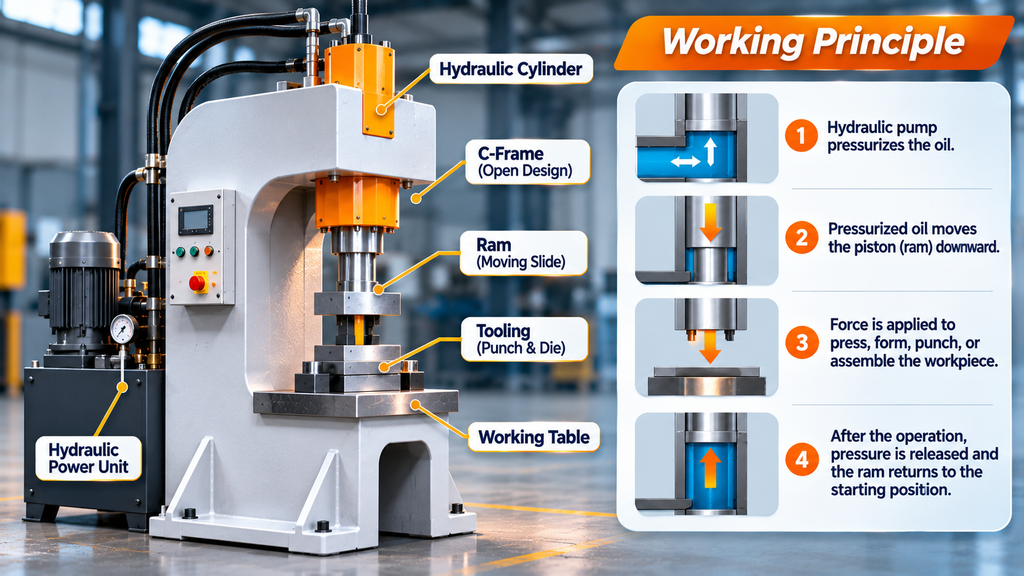
A C type hydraulic press working process is based on hydraulic pressure and the movement of a piston inside a cylinder.
The machine uses a pump to circulate hydraulic fluid through the system. When the operator activates the machine, the hydraulic system directs pressurized fluid into the cylinder.
The pressure moves the piston, which drives the ram downward toward the workpiece.
The ram applies force through the installed punch, die, fixture, or pressing tool. Once the required operation is completed, the control system reverses or releases the hydraulic flow to return the ram to its starting position.
Step-by-Step Working Process
1. Workpiece positioning
The operator places the component on the working table and aligns it with the required tooling.
2. Machine activation
The operator activates the machine using its control panel or operating controls.
3. Hydraulic pressure generation
The hydraulic pump draws fluid from the reservoir and supplies it to the hydraulic circuit.
4. Cylinder movement
Pressurized fluid enters the hydraulic cylinder and moves the piston.
5. Force application
The piston moves the ram downward, applying force to the workpiece through the tooling.
6. Manufacturing operation
The machine performs the required operation, such as punching, pressing, bending, straightening, or assembly.
7. Pressure release and return
After the operation, the machine releases pressure and returns the ram to its original position.
8. Component removal
The finished part is removed from the working area and inspected before the next cycle.
The operator can adjust parameters such as pressure, stroke, and speed according to the machine design and production requirements.
What Are the Main Components of a C-Frame Hydraulic Press?
A C-frame hydraulic press consists of several interconnected components that work together to generate and control pressing force.
1. C-Shaped Frame
The frame is the main structural component of the machine.
It supports the cylinder, working table, tooling, and applied loads. The frame must be designed to withstand pressing forces without excessive deformation.
A robust frame is important for maintaining machine reliability, tooling alignment, and consistent production quality.
2. Hydraulic Cylinder
The hydraulic cylinder converts hydraulic energy into mechanical movement.
It contains a piston that moves when pressurized fluid enters the cylinder. This movement produces the force required for the pressing operation.
Cylinder capacity, bore size, pressure rating, and stroke length influence machine performance.
3. Ram or Moving Slide
The ram is the moving component that transfers force from the cylinder to the workpiece.
It carries the punch, tool, fixture, or pressing attachment used for the manufacturing process.
4. Hydraulic Pump
The hydraulic pump supplies hydraulic fluid to the system and creates the flow required for machine movement.
The pump works with the electric motor and hydraulic circuit to control the machine’s pressing and return movements.
5. Hydraulic Fluid
Hydraulic fluid transfers energy throughout the system.
It also helps lubricate internal components and remove heat generated during operation. Proper fluid condition and maintenance are important for reliable machine performance.
6. Working Table
The working table supports the workpiece, die, fixture, or other tooling.
Its dimensions and construction should match the size and type of components being manufactured.
7. Control Panel
The control panel allows the operator to manage machine functions.
Depending on the design, it may include pressure adjustment, stroke control, speed settings, operating modes, emergency stop, and other control features.
8. Safety System
Safety features may include emergency stops, two-hand controls, guarding, safety sensors, pressure protection, and other mechanisms.
The required safety system depends on the machine design, tooling, application, and applicable safety standards.
What Are the Applications of a C Type Hydraulic Press?
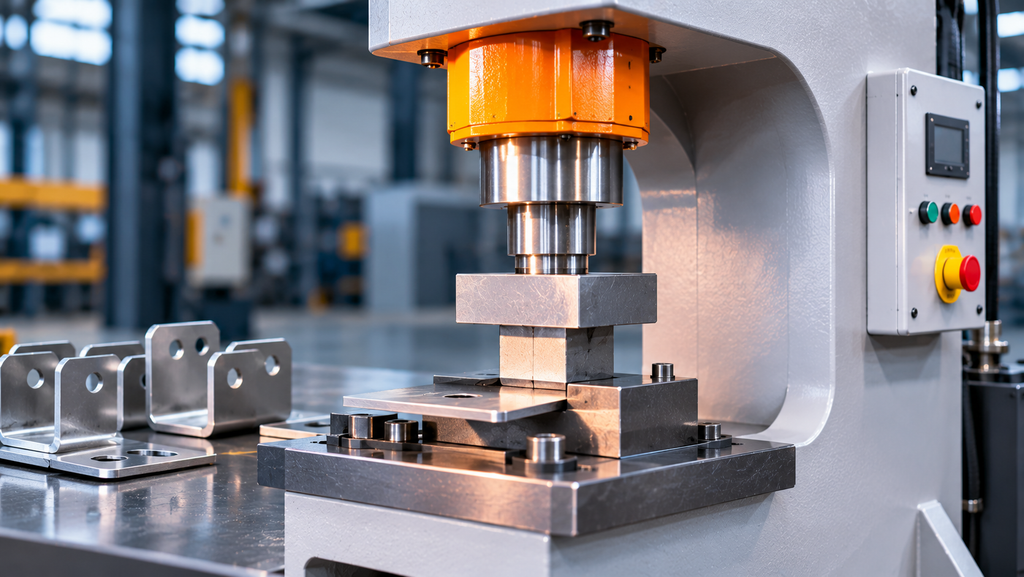
C-frame hydraulic presses are used across different manufacturing industries because their open structure supports flexible workpiece positioning and tooling arrangements.
The applications depend on the machine’s force capacity, stroke, bed size, tooling, control system, and operating configuration.
1. Metal Punching
A punch and die can be installed to create holes, slots, or specific shapes in metal components.
The open structure makes it easier to position smaller parts and handle different component configurations.
2. Sheet Metal Bending
The machine can perform selected bending operations using suitable tooling.
It is useful for small brackets, metal components, and forming applications where the required force and tooling fit within the machine’s capacity.
For long or complex sheet metal bending operations, a dedicated press brake may be more suitable.
3. Straightening Operations
A hydraulic press can correct bends or deformations in suitable metal components.
This application is common in workshops, fabrication facilities, and maintenance operations.
4. Press Fitting and Assembly
The machine can press bearings, bushes, sleeves, pins, shafts, and other components into their required positions.
Controlled force can help achieve repeatable assembly results when the tooling and process are properly designed.
5. Riveting and Joining
Selected riveting and joining operations can be performed using dedicated fixtures and tooling.
The machine applies controlled force to join two or more components.
6. Stamping and Forming
A suitable punch and die arrangement can support stamping, embossing, shallow forming, and selected metal-forming operations.
The tooling must be designed according to material properties, component geometry, and required production quality.
7. Trimming and Cutting
With suitable tooling, certain trimming and cutting operations can be performed.
The required force depends on the material, thickness, cutting geometry, and size of the operation.
8. Component Manufacturing and Assembly
C-type machines are commonly suitable for manufacturing environments where multiple operations are performed on individual components.
Their open design can help simplify component handling and work positioning.
What Are the Benefits of Using a Hydraulic Press with a C-Frame Design?
The benefits of using a hydraulic press with a C-frame structure are mainly related to accessibility, flexibility, compactness, and operation.
Easy Access to the Working Area
The open frame provides access from the front and sides.
This makes loading and unloading easier, especially when handling individual components, fixtures, and small dies.
Compact Machine Design
C-frame machines are often suitable for workshops and production areas where floor space is limited.
Their structure can provide a practical working arrangement without requiring the footprint of a larger press.
Flexible Applications
The same machine can perform different operations by changing punches, dies, fixtures, or tooling.
This versatility can be useful for manufacturers handling different components or smaller production batches.
Convenient Tool Changes
The accessible working area can simplify tooling installation, adjustment, inspection, and removal.
This may help reduce setup time when production requirements change.
Controlled Pressing Force
Hydraulic operation allows the machine to apply and control force according to the selected operating parameters.
Depending on the machine configuration, pressure, speed, and stroke can be adjusted for different applications.
Suitable for Custom Manufacturing
C-frame machines can be designed or configured around specific production requirements.
Custom table dimensions, cylinder capacities, stroke lengths, tooling arrangements, and automation features may be available depending on the manufacturer.
What Are the Limitations of a C Type Hydraulic Press?
Although C-frame machines provide useful advantages, their structural design also has limitations.
Frame Deflection
The open frame can experience deflection when force is applied, particularly under heavy or off-centre loading.
Excessive deflection may affect tooling alignment, product accuracy, and machine durability.
Load Positioning
The workpiece should be positioned appropriately within the working area.
Applying force away from the intended centreline can increase structural stress and affect machine performance.
Limited Capacity for Certain Operations
A C-frame design may not be the ideal option for every high-tonnage or large-area forming application.
The machine’s frame rigidity, cylinder capacity, table dimensions, and tooling must match the operation.
Application-Specific Accuracy
Some applications require greater structural rigidity and more controlled alignment than a standard C-frame machine can provide.
For such requirements, another frame design may be more appropriate.
Selecting the machine according to the actual application is therefore important.
What Are the Different Types of Hydraulic Presses?
Hydraulic presses are available in different frame designs and configurations. Each type is developed to support specific manufacturing requirements.
C-Frame Hydraulic Press
A C-frame machine offers an open working area and convenient access.
It is suitable for pressing, assembly, punching, straightening, and selected forming operations.
H-Frame Hydraulic Press
An H-frame machine uses a more enclosed structural arrangement with vertical supports.
It is commonly selected for applications that require a rigid structure, heavier pressing operations, straightening, or larger workpieces.
If your manufacturing operation requires a different structural design, you can explore an h type hydraulic press to understand its construction and applications.
Four-Column Hydraulic Press
Four-column machines use vertical columns to support and guide the moving platen.
They can be suitable for applications requiring a larger working area, guided movement, and a more rigid structure.
Manual Hydraulic Press
A manual hydraulic press uses a manually operated pump to generate hydraulic pressure.
It is generally suitable for smaller pressing requirements, workshop operations, maintenance work, and applications where automated production is not necessary.
Electric Hydraulic Presses
Electric hydraulic presses use an electric motor and hydraulic power unit to generate and control pressing force.
They may include adjustable pressure, stroke controls, automated operating sequences, and other features depending on the configuration.
Different types of hydraulic presses should be evaluated according to force requirements, component dimensions, production volume, accuracy, and the nature of the operation.
C-Frame Hydraulic Press vs H-Frame Hydraulic Press: Which Is Better?
The choice between these machines depends on the production application rather than simply the machine’s name or rated capacity.
| Feature | C-Frame Hydraulic Press | H-Frame Hydraulic Press |
|---|---|---|
| Frame design | Open C-shaped frame | Supported H-shaped structure |
| Working access | Front and side access | Depends on design |
| Loading and unloading | Convenient for individual components | Suitable for larger workpieces |
| Structural rigidity | Depends on frame construction | Generally more rigid structural arrangement |
| Applications | Pressing, assembly, punching, forming | Heavy pressing, straightening, forming |
| Space requirement | Often compact | May require more space |
| Best suited for | Flexible workstation operations | Applications requiring stronger support |
A C-frame machine may be the better option when accessibility and flexible component handling are priorities.
An H-frame machine may be more suitable when the operation requires greater structural support, a larger work area, or heavy-duty pressing.
How Do You Choose the Right C Type Hydraulic Press?
Choosing the right hydraulic press requires understanding your manufacturing process.
The machine should be selected according to the force required, workpiece dimensions, tooling, production volume, and operating conditions.
1. Identify the Application
First, determine the operation the machine will perform.
Is it used for punching, pressing, straightening, assembly, bending, trimming, or forming?
Different applications require different tooling and machine configurations.
2. Determine Required Tonnage
The required force depends on the material, thickness, component dimensions, tooling, and manufacturing operation.
Selecting a machine with insufficient capacity can result in incomplete operations or excessive loading.
3. Check Table Dimensions
The working table should provide sufficient space for the workpiece, tooling, and fixtures.
Consider the dimensions of both current and future components.
4. Evaluate Stroke Length
The stroke length should provide enough movement for tool clearance, component loading, pressing, and unloading.
The required stroke varies according to the operation and tooling.
5. Review Operating Speed
Production requirements may influence the required approach speed, pressing speed, and return speed.
Machines used for repetitive production may require more advanced operating controls.
6. Consider Automation Features
For repetitive manufacturing operations, automation features may improve productivity and reduce manual handling.
Depending on requirements, the machine may include PLC controls, sensors, automatic feeding, programmed cycles, or other production integration features.
7. Evaluate Safety and Maintenance
Check safety controls, guarding, emergency stop systems, hydraulic components, maintenance access, and operating instructions.
A properly designed and maintained machine supports safe operation and long-term reliability.
Why Is a C Type Hydraulic Press Important in Modern Manufacturing?
Modern manufacturing requires machines that can perform operations consistently while adapting to different production needs.
A C-frame hydraulic press supports this requirement through its accessible structure, controlled pressing force, and flexible tooling arrangements.
It can be used for individual operations or integrated into production lines where component handling and repeatability are important.
Depending on its configuration, a machine may support manual operation, semi-automatic cycles, or automation features.
Manufacturers can use these machines for metalworking, assembly, fabrication, component production, and various industrial applications.
The machine’s actual productivity depends on its capacity, tooling, operating speed, material handling process, and production requirements.
Conclusion
A C-type hydraulic press is a versatile industrial machine that uses hydraulic pressure to perform pressing, punching, forming, straightening, assembly, and other manufacturing operations.
Its C-shaped frame provides convenient access to the working area, making it useful for applications involving frequent component positioning and tooling changes.
When evaluating what is a C type hydraulic press, it is important to understand not only its structure but also its working principle, capacity, applications, benefits, and limitations.
The right machine should match the required force, tooling, workpiece dimensions, production volume, and accuracy.
For manufacturing businesses looking for suitable industrial pressing solutions, Purvaj Engineers provides hydraulic press machine solutions designed for different industrial requirements.
Frequently Asked Questions
What is a C type hydraulic press?
A C type hydraulic press is a machine with a C-shaped frame that uses hydraulic pressure to apply force to a workpiece. It is used for pressing, punching, bending, straightening, assembly, and other manufacturing operations.
How does a C type hydraulic press work?
The machine uses a hydraulic pump to circulate pressurized fluid into a cylinder. The fluid moves the piston and ram, which apply force to the workpiece through the installed tooling.
What are the main C frame press applications?
Common applications include punching, pressing, straightening, bending, riveting, press fitting, trimming, stamping, and component assembly.
What are the advantages of a C-frame hydraulic press?
Its main advantages include easy access to the working area, convenient component handling, compact design, flexible tooling, and suitability for different manufacturing operations.
What is the difference between a C-frame and an H-frame press?
A C-frame press has an open structure that provides convenient access to the working area. An H-frame press has a more supported structural design and is often selected for applications requiring greater rigidity or heavier pressing operations.
Can a C type hydraulic press perform sheet metal bending?
Yes, selected bending operations can be performed using suitable tooling. However, the machine’s force capacity, tooling, workpiece dimensions, and frame rigidity must be suitable for the bending application.
How do I select the correct tonnage for a hydraulic press?
The required tonnage depends on the material, thickness, workpiece size, tooling design, and manufacturing operation. The force requirement should be calculated according to the specific application rather than selected randomly.
Which industries use C-type hydraulic presses?
C-type machines are used in metal fabrication, automotive component manufacturing, electrical equipment production, general engineering, industrial assembly, maintenance workshops, and other manufacturing industries.